Research Article | | Peer-Reviewed

Collage as a Sustainable Environmental Practice - Centred on Nigerian Female Avant-Garde Artist Osague

Received: 1 December 2025     Accepted: 22 December 2025     Published: 19 January 2026
Views:       Downloads:
Abstract

This paper discusses recycling of “off-cut” fabrics as materials for mixed-media collage-making activities centred on Osague Osagiede Paulina; the Nigerian Female avant-garde artist. With the aid of the internet, journals, books and others, the collage activities of some female artists - Sienna Martz, Kara Williams, Wangechi Mutu and, Njideka Akunyili Crosby - were studied to point out some related patterns, similarities of concept and materiality to Osague’s. For the purpose of this study, the Judgemental sampling technique was used in selecting sixteen (16) mixed-media collages from Osague’s oeuvres. Those selected were analysed revealing some of the philosophy and passion underpinnings her creating collages based on her childhood memories. The descriptive/narrative readings of the (16) collages - as visual-data - was achieved with the following themes - playful times; alone and together and, so on. In conclusion, this paper is of the view that Osague’s collages are significant contributions in narration of the “story” of a resolute artist who, being female, faces a number of challenges masked in social-constraints; of identity; emotional abuses; depravity and others. This paper recommends the collage-making approaches of this artist should be adopted by knowledge seekers in art and design as a resource material in teaching, learning and research in sustainable environmental practices.

Published in American Journal of Art and Design (Volume 11, Issue 1)
DOI 10.11648/j.ajad.20261101.12
Page(s) 11-18
Creative Commons

This is an Open Access article, distributed under the terms of the Creative Commons Attribution 4.0 International License (http://creativecommons.org/licenses/by/4.0/), which permits unrestricted use, distribution and reproduction in any medium or format, provided the original work is properly cited.

Copyright

Copyright © The Author(s), 2026. Published by Science Publishing Group

Keywords

Recycling, Femininity, Collage, Off-cut-Fabrics, Mixed-media, Contemporary

1. Introduction
Contemporary or modern art as the case may be, is the art of the “present-day” and, in many a sense, registers for the “future” what the future “present art” is. This view point supports the art of “collage” making which is one of the ancient art forms dating back to the 10th century in Japan. However, contemporary collage history can be traced to Pablo Picasso who was one of the 20th century’s renowned artist. Scholars and historians recorded Pablo Picasso and Georges Braque as those who popurlarised modern collage practices when they started adding pieces of fabrics, newspaper cuttings and so on in their artworks. Still Life with Chair Caning, produced in 1912 in which Picasso had an oilcloth glued to canvas, and “Fruit Dish and Glass” a form of papier colle with wall paper created by Braque in 1912, respectively glued to canvas being some of the early examples of this genre . This idea gained more traction as other artists adopt and adapted it in their works. Despite derision of such works by the public due to their unconventional posture, they later shaped several 20th century art movements - Dadaism, pop art, futurism, fauvism, surrealism and the others. These avant-gardes approaches in art creation, attest to some of the root causes of the revolutions taking place in the visual arts through the ages .
The creative power of collage to bring together and interpret a “story” or “re-story” our everyday experiences is not in dispute. Notable scholars have continue to state that the technique of collage does not seem to have fallen out of fashion as the use of different materials in art has reached an explosive proportion and that, the direction is no longer comprehensible . In similar vein, avant-garde artists in Nigerian are also exploring diverse materials – “off-cut” fabrics; newsprints; plastics and all manners of discarded “junks” in sustainable environment practices . This paper aims to make a reading of Osague Osagiede Paulina’s collage-making activities by x-raying her femininity, identity, childhood memories; love; morality and so on.
2. Literature Review
As earlier noted, Picasso, Braque, and Spanish painter Juan Gris, Henri Matisse, Robert Rauschenberg and others were renowned collage-making artist who create some of traditional -papier Colle, Decoupage, photomontage, assemblage approaches currently being applied by contemporary artists . This review notes that a lot of contemporary collagists; though restless in their creative fervor, still apply these techniques in pushing creativity to a greater height with discarded items. This review highlighted the works and collage making approaches of a number of “female” collagist that appears similar to Osague Osagiede Paulina’s. For instance, Sienna Martz is an internationally renowned collagist known for bringing eco-friendly art to life with materials sourced from secondhand clothing and plant-based fibers . This review observes that Sienna Martz uses both traditional painting, sculpture – fiber techniques combine with textiles technique of sewing, knotting, weaving in creating her exquisite collage (See Figures 1 and 2).
Figure 1. Flow through the Hues, 2024. Flow through the Hues, 2024.
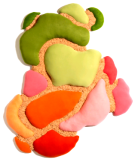
Figure 2. Echoes of Earth I, 2025. Echoes of Earth I, 2025.
One of her collage works titled “Flow through the Hues”, 2024 is made from upcycled-fabric, organic kapok fiber, thread, eco-friendly paint, linseed oil, mounted on wood, 49” x 29” x 11/2” or 124.5 x 73.7 x 3.8 cm. While “Echoes of Earth I”, 2025 is made with upcycled-fabric, organic kapok fiber, bamboo felt, thread, and eco-friendly paint mounted on birch panel, 46”x35”x3.5” .
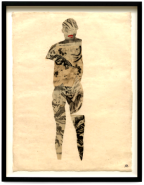
Also, in July of 2022 at the Stephen Friedman Gallery, an exhibition of 16 contemporary female artists titled “From near and far: Collage and Figuration in the Contemporary Age” was held. The exhibition highlighted collage-making as a “concept” and “art form”. Much of the over 20 works on display had never been shown before comprise majorly figurative forms and viewpoints. Presenting her views on the exhibits, the curator observes that the works demonstrated “how artists uses collage in dissecting political and social norms embedded in mainstream visual culture and expose fractured aspects of society whilst also presenting images of” unity . The artists used their collage to explore different making techniques - “photomontage”, “painting collage” among others. These works addresses issues of ‘Unity; Freedom; Power; Identity; Politics; and Justice, connecting “thoughts” with visuals and words. Anne Rothenstein works titled “Tattoos and Red Lips”, 2022; and “The Crowd”, 2022 are in monoprints on vintage paper mounted on handmade Lokta paper and, measures 72cm x 56cm and 72cm x 56cm respectively (See Figures 3-4).
Figure 3. Tattoos and Red Lips, 2022.
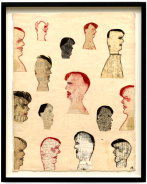
Figure 4. The Crowd, 2022. The Crowd, 2022.
In addition, other notable artists horning their collage making craft includes the American trios of Kara Williams, b.1969; Lorna Simpson, b.1960 and; Deborah Roberts, b.1962. Also, Wangechi Mutu, b. 1972; Njideka Akunyili Crosby, b.1983; Uzo Njoku and Akpojotor Marcellina to mention but a few are telling their femininity “stories” of - identity; politics; different shades of depravities encountered in the complex journey of African women - in “collage making” as sustainable environmental practice .
Osague Osagiede Paulina’s passion and philosophy underpinning her collage-making approach shows a lot of relationship with the aforementioned artists as well as Sienna Martz who is been referred to as eco-friendly artist . Like Sienna Martz’s, Osague’s collage-making activities are deeply steeped in recycling discarded “off-cut” fabrics that visualises her childhood innocence as a sustainable environmental practice. In conclusion, though, Osague’s “collage-making” activities are not in any ways new, the ways she integrate the subjects/objects - motifs, patterns, colours to mention but a few shows her dexterity in the act of collage making .
3. Methodology
It’s been well noted that “artistic methodology” is a “pluralist process” involving multi-method technique, tailored to the individual project . In this paper, the author applied both Visual/Descriptive and Narrative Analysis in reading Osague’s selected collages. These methods can be used separately or in combination for evaluation and analysis of data created by oneself and, or others . Sixteen (16) collages from Osague’s oeuvres were selected based on the purposive sampling techniques. Identity, childhood memories, love, design elements - motifs, patterns, colours to mention but a few formed the basis of the analysis. Osague explains the approach she applies in collection of data (that is, the discarded “off-cut fabrics - cotton, waxed, silk, wool) as follows;
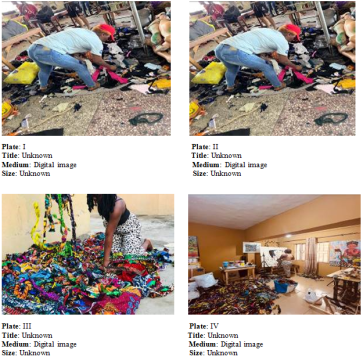
I frequent marketplaces where clothes are produced and tailor shops where fabrics are shaped into garments. These are the two key places where I gather my materials. In tailor shops, I collect fabric cutouts—scraps that have been trimmed from the main pieces used for making dresses. These cutouts, often discarded in bins, are where I find much of my fabric. Additionally, I visit production houses in Lagos, where I sometimes source fabric from rolls or leftover cutouts from the manufacturing process.
Figure 5. Collection of Discarded “off-cut” fabrics. Collection of Discarded “off-cut” fabrics.
The data (silk, cotton, tulle) and especially, the “Ankara” fabrics portraying African historical stories - motifs, colours, patterns, content, context and so on - visible and integral to her collage-making activities are sorted and categorised into certain themes and, or subject matters that resonate with hers and, or the viewer’s anticipation. Marcellina Akpojotor, Nigerian Visual Artist is also noted for using scraps of ‘Ankara’ in her collage-making activities (Plate I-II); (see Figure 5).
4. Analysis and Discussion
Clearly, the (16) collages selected for reading presents both visual, descriptive/narrative “restorying” of Osague’s idiosyncrasies in text. A full time studio artist, she focuses on collage-making that personify her experiences in a patriarchal society. Currently though, some of her collages portray male-subjects that narrates a range of issues connected to mans’ struggles in life. The technique she applies in this collages is “machine-stitching”. According to the artist, there are no formal ordering in creating her collages with “off-cut” fabrics. Each work, according to her, comes with its own process, especially after a visitation to tailoring stores sourcing more fabrics in the neighbourhood. She uses her collage in interrogating issues of cultural identity, childhood memories – playfulness, work, loneliness, time, warmth and so on. Though these themes are discrete, they are aggregate in many ways in content and context.
Playful Times
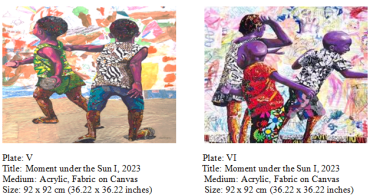
Figure 6. Playful Times (I).Playful Times (I).
Under this theme (Playful Times (I), “Moment under the Sun I”, Plate.(v) and “Moment under the Sun II” Plate (vi) both produced in 2023 respectively, are set in warm oranges and tones of brownish colours as well as different tints and shades of purples are selected for a reading. In both collage, the children are portrayed in playful mood; carefree, happy and oblivious to the problems of the world. The images are set in African context where play is a key cultural activity - often in display during festivities. Under the moonlight, children often indulges in story telling or playing hide and seek games; they bound, creating warmth and a life time of memories. These experiences do not last forever but can only be relive through fantasy with a smile. This is poignant just as the artist opines “children live every single moment of their lives at a time with zero worry about life”. The artist went on to state that this collage reminds the viewer to loosen up, relive some memories by imagination and positivity to enjoy infinite freedom.
Figure 7. Playful Times (II).Playful Times (II).
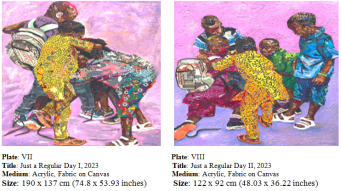
Under this theme (Playful Times II), the artists uses the collage in plate vii and viii to further explore the subject (see Figure 7). Playful times are a time to play, to fight, to quarrel and settle differences. This mixed media painting captures a group of boys hunting for a specific ‘thing’, each dressed uniquely to represent different identities – dreams, vision, expectations, depravities etc. Indeed, just a Regular Day I and, Just a Regular Day II as the titles imply, symbolises these unchanging constancy in the life cycle of man – the essences of friendship and shared subtleties. The lessons, the mistakes and growth we have had to experience in order to learn. That ultimate sense of nostalgia; the reflections, blending, longings and appreciation of our individualities as a collective in the journey of the living regardless of the up and downs.
Figure 8. Love and Work.Love and Work.
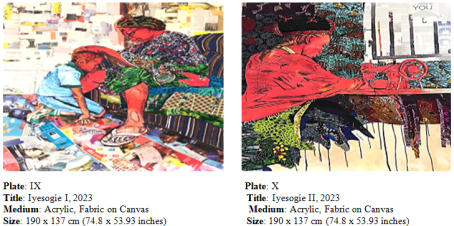
Under this theme (Love and Work), two collages were analysed. In the work titled Iyesogie I, the artist depicted a mother with her hands laid on her daughter’s head. She is probably praying for her to have wisdom knowing that she will be growing up in environment surrounded by powerful foreign influences that could easily distract her from observing lesson of the culture and traditions. Despite the curriculums in school being mostly filled with foreign influences, it doesn’t stop ‘Iye’ (mother) from instilling both her indigenous culture and traditional skills to her child. In “Iyesogie II”, the mother is seen in her tailouring shop sewing and patching cloth – her source of lively which the artist earlier on alluded.
Alone and Together
Figure 9. Alone and Together (I).Alone and Together (I).
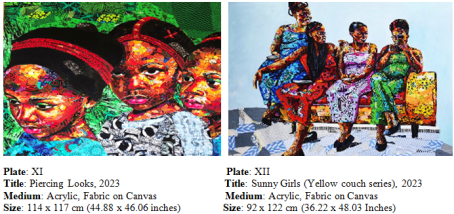
Four collages were selected for a visual analysis of this theme; Alone and Togetherness (See Plates xi, xii, xiii and xiv in: Figure 9). In Plate XI for instance, the artist creates a picture explaining an aspect of the human condition by portraying the “eyes” of the three little children. This collage may have gotten its “Piercing Looks” title from the staring eyes of the girl-child in the middle of the picture. Her innocence and disposition in this figurative expression presents the viewer opportunity to muse the probable cause(s) of the children seemingly moody stares; due perhaps, to social, parental/teachers’ expectations. Children are generally open and humane whilst growing to adulthood.
Figure 10. Alone and Together (II). Alone and Together (II).
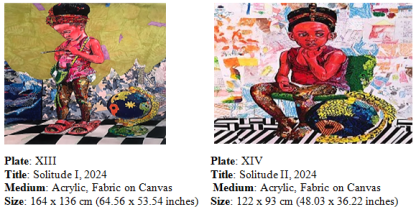
The artist, through these collages titled “Solitude 1” and “Solitude 2” depicted a babe (female) in two different moments of her life with her toy. In the collage titled “Solitude I”, she stands in oversized shoes, symbolising her aspirations for a better future. She is half-dressed in traditional attires that represents her cultural identity. The background portrays the boundless nature of her imagination and her yearning for freedom. While in “Solitude II”, she appears to be comfortably seated on a chair, gazing meditatively into the distance. These collages invite the viewer in to a reflective state, suggesting that childhood experiences can sometimes impose limitations, restricting one’s ability to explore and thrive independently. This resonates with the universal challenge of facing life’s obstacles; social-constraints, emotional abuses and so on. While we may face these solitary state of affairs by ourselves, it reminds us not to always stand alone.
Figure 11. Alone and Together (III). Alone and Together (III).
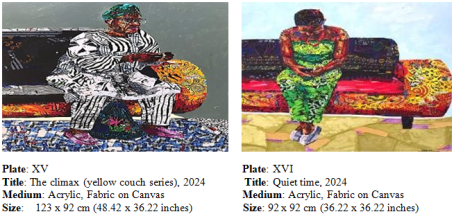
The artist claims that she had visualised her observations and lessons learnt as a girl-child being raised by her loving father in this collage titled “Climax”. As it would be observed in the collage titled “Sunny Girls” (plate xii), the yellow couch reappeared, symbolising a moment of reflection in time (see Figure 11). According to Osague, this work evokes a memory in regards to her father who appeared to have regularly sat on a couch in the veranda while staring at the sky. Osague notes that in those moments, her father was perhaps, contemplating his legacy regarding the life he lives and, whether he had imparted the right values on his children after he may have passed on. The artist appears be telling everyone about the transient nature of life - the beginning and the end - the conclusion of man’s life on earth and time without end – the bliss.
As would rightly be observed in the collages titled “Climax” (Plate. xv) and “Sunny Girls” (Plate. xii) the yellow couch can also be seen in another of her collage titled “Quiet Time” (Plate. xvi); (see Figures 9, 11). The viewer would notice a woman that is seated on a couch with her head bowed while looking at her phone. The artist claims that this artwork is her personal reflection of her nostalgia regarding the solitary moments she had that also open her to several opportunities to reflect about life. To her, the work affirms the cliché that being alone doesn’t always mean being lonely; instead, such moments are also valuable to introspect and self-dialogue on how best to positively impact others’ lives. The work represents such moments that one could have used making thoughtful and important decisions about life.
The colours in this collage portray those “bright” and “darkest” times of such moments because, “change or transformation” in some ways; reflects the genius who understands the environment as well as the social cultural dictates of the visual elements portrayed in the most satisfying media of choice . In other words, as scientists’ searches for truth in nature, so do artists’ when they observe and portray the birds, the intricacies of a leaf, the changing clouds and so on. Hence, to the extent to which artists’, in hands and mind, contextualise things in the preferred media, so is their ability . This submission is analogous to a conversation in which “artists” as the conversationalist, create works of art as though it were a conversation .
5. Conclusion
This paper has presented a reading of the 16 selected collages of Osague as visual communication tools enabled by the elements and principles of design - lines, colours, texture, space, and so on. Like every artist, the possibility of the viewer understating her artworks depends on how well the pictorial elements in her collages are appreciated. She concludes that even though the materials in her collages are sourced from discarded off-cut fabrics, there is need to sort and organise them into certain arrangements – colour gradation, lines, patterns etc., before using them to create collages that would last a life time. The collages should be kept away from moist and sunny conditions. She concludes that her collages would be most aesthetically appealing when properly framed and hung indoors.
6. Recommendation
Though collage making with off-cut fabrics is unique, the process is quite technical, dramatic, emotionally provocative and, fun. To create excitingly creative collages, this paper recommends the use of diverse fabrics - cotton, waxed, silk, wool, denim, and tulle - with high textural qualities. Collagists are also recommended to either purchased or discarded fabrics to reduce overhead cost. Though other surfaces are available, canvases appear more convenient. It is therefore recommend that it should be primed with glue and left to dry before sketching the concept for the collage. To create an impactful, aesthetically pleasing collage, the artist recommends creating collages by working from the darkest to lighter tones until the work is completed.
Author Contributions
Akprara Amos Osakor is the sole author. The author read and approved the final manuscript.
Conflicts of Interest
The author declares no conflicts of interest.
References
[1] Abdunrin, J. A. (2018). Non-conventional materials and Nigeria’s post modernist’s paintings: an assignment. ISSUES IN ART: Research, Pedagogy and Practice in Nigeria. A Festschrift in Honour of Best Ochigbo at 60. Published by the Department of Fine and Industrial Design, University of Uyo, Nigeria, (ISBN 978) Pp. 161-172.
[2] Akpojor, M. Nigerian Visual Artist Uses Scraps of ‘Ankara’ Fabric to Create Collages. Available at:
[3] Beach, C. (2024, August 16). Fiber Artist Sienna Martz takes a stand against secondhand Materials.
[4] Gamboa, C. (2024, August 27). Sienna Martz’s Ethical Life-Practice. Available online at:
[5] Gardner, H. (1970). Art through the Ages. Harcourt and Brace Jovanovich, New York. Vol. 12.
[6] Gombrich, E. H. (1967). The Story of Art. Phaidon Press.
[7] Gray, C and Malins, J. (2004). Visualising research: a guide to the research process in art and design. London. Ashgate Publishing Limited, p. 72.
[8] Gushem, P. O. (2006). Styles and Innovations: a critical look at some Simon Ochigbo’s use of unconventional media in Painting. Egghead. A Journal of Art (Special Edition). Department of Fine Arts, Ahmadu Bello University, Zaria, Nigeria, Pp. 37-40.
[9] Hessel, K. (2022). (Curator). From near and far: Collage and Figuration in the Contemporary Age. Available online at:
[10] Ijisakin, (2006). Visual communication with beads: a critique of Jimoh Braimoh’s Ingenuity. In: Egghead. A Journal of Art (Special Edition). Published by the Department of Fine Arts, Ahmadu Bello University, Zaria, Nigeria, Pp. 12-15.
[11] Jason, R. (2020, July/August). Njideka Akunyili Crosby with Jason Rosenfeld. Available online at:
[12] Jonathan, D. E. and Gbaden, B. G. (2018). Fabrics as supplement and substitute: a case study of Blaise Gbaden’s Kinetic paintings and installations. In: Resonance. A journal of contemporary arts scholarship (maiden issue), published by the Department of Visual and Creative Arts, Federal University, Lafia, Nigeria, Pp. 123-128.
[13] Lawrence, D. (2020). 5 Contemporary Black Female Artists using paper and Collage in their Art Practice. Available online at:
[14] Mallikarjun, C. B. (2024). Collage Art: In the Context of Contemporary Aspirations. International Education and Research Journal, Vol. 10 No. 9 (2024): September Issue. Available online at:
[15] Muhammad, A. and Ibrahim-Goodman, D. (2018). Creative Ingenuity of Peju Alatise’s Cloth Collage. In: Resonance. A journal of contemporary arts scholarship (maiden issue), published by the Department of Visual and Creative Arts, Federal University, Lafia, Nigeria, Pp. 52-56.
[16] Nandwani, K. (2023). Sienna Martz: Eco-conscious Textile Artist. Available at: htpps://lociwear.com/blogs/news/
[17] Noel, C. (2001). Beyond Aesthetics: Philosophical Essays. Pub: Cambridge University Press, Pp. 104.
[18] Read, H. (1977). The Philosophy of Modern Art. London. Faber and Faber.
[19] Uzo, N. Nigerian Contemporary and Graphic Artist. Access Available at:
[20] Vaughan, K. (2005). Collage as an Artist's Method for Interdisciplinary Research.
[21] Wojciech, D. (2019). Theory and Practice of Collage. Available online at:
[22] Sienna Martz-Biography, Shows. Available at:
Cite This Article
  • APA Style

    Osakor, A. A. (2026). Collage as a Sustainable Environmental Practice - Centred on Nigerian Female Avant-Garde Artist Osague. American Journal of Art and Design, 11(1), 11-18. https://doi.org/10.11648/j.ajad.20261101.12

    Copy | Download

    ACS Style

    Osakor, A. A. Collage as a Sustainable Environmental Practice - Centred on Nigerian Female Avant-Garde Artist Osague. Am. J. Art Des. 2026, 11(1), 11-18. doi: 10.11648/j.ajad.20261101.12

    Copy | Download

    AMA Style

    Osakor AA. Collage as a Sustainable Environmental Practice - Centred on Nigerian Female Avant-Garde Artist Osague. Am J Art Des. 2026;11(1):11-18. doi: 10.11648/j.ajad.20261101.12

    Copy | Download

  • @article{10.11648/j.ajad.20261101.12,
      author = {Akprara Amos Osakor},
      title = {Collage as a Sustainable Environmental Practice - Centred on Nigerian Female Avant-Garde Artist Osague},
      journal = {American Journal of Art and Design},
      volume = {11},
      number = {1},
      pages = {11-18},
      doi = {10.11648/j.ajad.20261101.12},
      url = {https://doi.org/10.11648/j.ajad.20261101.12},
      eprint = {https://article.sciencepublishinggroup.com/pdf/10.11648.j.ajad.20261101.12},
      abstract = {This paper discusses recycling of “off-cut” fabrics as materials for mixed-media collage-making activities centred on Osague Osagiede Paulina; the Nigerian Female avant-garde artist. With the aid of the internet, journals, books and others, the collage activities of some female artists - Sienna Martz, Kara Williams, Wangechi Mutu and, Njideka Akunyili Crosby - were studied to point out some related patterns, similarities of concept and materiality to Osague’s. For the purpose of this study, the Judgemental sampling technique was used in selecting sixteen (16) mixed-media collages from Osague’s oeuvres. Those selected were analysed revealing some of the philosophy and passion underpinnings her creating collages based on her childhood memories. The descriptive/narrative readings of the (16) collages - as visual-data - was achieved with the following themes - playful times; alone and together and, so on. In conclusion, this paper is of the view that Osague’s collages are significant contributions in narration of the “story” of a resolute artist who, being female, faces a number of challenges masked in social-constraints; of identity; emotional abuses; depravity and others. This paper recommends the collage-making approaches of this artist should be adopted by knowledge seekers in art and design as a resource material in teaching, learning and research in sustainable environmental practices.},
     year = {2026}
    }
    

    Copy | Download

  • TY  - JOUR
    T1  - Collage as a Sustainable Environmental Practice - Centred on Nigerian Female Avant-Garde Artist Osague
    AU  - Akprara Amos Osakor
    Y1  - 2026/01/19
    PY  - 2026
    N1  - https://doi.org/10.11648/j.ajad.20261101.12
    DO  - 10.11648/j.ajad.20261101.12
    T2  - American Journal of Art and Design
    JF  - American Journal of Art and Design
    JO  - American Journal of Art and Design
    SP  - 11
    EP  - 18
    PB  - Science Publishing Group
    SN  - 2578-7802
    UR  - https://doi.org/10.11648/j.ajad.20261101.12
    AB  - This paper discusses recycling of “off-cut” fabrics as materials for mixed-media collage-making activities centred on Osague Osagiede Paulina; the Nigerian Female avant-garde artist. With the aid of the internet, journals, books and others, the collage activities of some female artists - Sienna Martz, Kara Williams, Wangechi Mutu and, Njideka Akunyili Crosby - were studied to point out some related patterns, similarities of concept and materiality to Osague’s. For the purpose of this study, the Judgemental sampling technique was used in selecting sixteen (16) mixed-media collages from Osague’s oeuvres. Those selected were analysed revealing some of the philosophy and passion underpinnings her creating collages based on her childhood memories. The descriptive/narrative readings of the (16) collages - as visual-data - was achieved with the following themes - playful times; alone and together and, so on. In conclusion, this paper is of the view that Osague’s collages are significant contributions in narration of the “story” of a resolute artist who, being female, faces a number of challenges masked in social-constraints; of identity; emotional abuses; depravity and others. This paper recommends the collage-making approaches of this artist should be adopted by knowledge seekers in art and design as a resource material in teaching, learning and research in sustainable environmental practices.
    VL  - 11
    IS  - 1
    ER  - 

    Copy | Download

Author Information